Review manipulation involves intentionally steering customer feedback to create a more positive picture than would emerge naturally. It now carries severe legal and platform penalties.
Google’s recent policy updates ban asking for employee names, setting staff review quotas, pressuring customers on-site, and suggesting specific keywords.
Prohibited practices include fake or AI reviews, review gating, buying positive ratings, hiding negative feedback, and using shared company devices.
Businesses can still legally gather reviews in a variety of ways.
Enforcement has spiked because AI-driven search engines now scan and rely on authentic review text to recommend local businesses.
Review manipulation is any intentional action that disrupts or steers a customer’s natural feedback process. For a local service business, this includes faking reviews, selectively hiding negative complaints, or controlling exactly what, when, and how a customer posts their experience online.
Why is it important to know about review manipulation now? Because online reviews are more important than ever for service businesses (yes, really!) – and the penalties for review manipulation can be extremely costly.
With the stakes higher than they’ve ever been before, let’s take a look at what has changed recently with review manipulation and how you can make sure you stay compliant.
The Big Recent Change? The Maps Rating Manipulation Policy Update in April 2026
Ever read online reviews for a business and a bunch of them mention the same person over and over? “John is the best. Quick worker and always polite.” “Great service and appreciate the effort from John.” “Nobody knows how to use a drain snake like John.”
Maybe John really is that great, but there’s a better chance that he keeps getting mentioned because he’s good at asking customers for reviews. That gives us some insight into why Google has started cracking down on reviews that mention employees by name: There’s a high correlation between reviews that specifically praise one employee and review manipulation.
To eliminate these kinds of unnatural patterns, Google rolled out a massive, two-day overhaul to its official Maps Rating Manipulation policy. You can peruse Google’s full policy on prohibited and restricted content here, but the most important thing to know are the changes. In a single update, these common practices were transformed into explicit violations:
No Soliciting Employee Names: You cannot ask or prompt a customer to explicitly mention your technician’s name in their review. Google’s AI now flags profiles where employee names pop up repetitively and may automatically filter those reviews.
No Staff Review Quotas: You can no longer force your team to hit a specific number of reviews (e.g., “Everyone needs 3 reviews this week”). Google banned this because pressure to hit a number directly causes employees to badger customers for name-drops or fake the reviews themselves.
No On-Premises Pressure: You cannot require or pressure a customer to leave a review while you or your technician are still standing in their living room, at checkout, or on their property. Google’s updated guidelines explicitly state that review requests must give customers space to leave feedback on their own time, away from the point of service.
No Suggesting Keywords: Just like you can’t ask for a name-drop, you are now banned from telling a customer what specific services or city names to type (e.g., “Make sure to say we did a water heater installation in Dallas”). Google’s AI now actively screens for repetitive keyword patterns across your profile and will automatically wipe them out.
Will Google Automatically Delete or Filter Out Reviews That Mention Employee Names?
No, and this is an important nuance to understand. Google’s AI isn’t hunting down every single review that says “Thanks, Dave!” and instantly vaporizing it. It’s entirely natural for a customer to occasionally remember a friendly technician’s name on their own.
Instead, Google’s AI looks for unnatural patterns and density. A single review with those kinds of flags is just one data point. Multiple data points over a short period reveal a trend, and a trend is what Google uses as evidence that review manipulation is happening.
However, because this is an automated, AI-driven filtering system, it can and will get it wrong sometimes. Perfectly legitimate reviews from happy homeowners might occasionally get caught in the crossfire and filtered out. But as long as it’s a real review from a real customer that represents their real sentiments, you shouldn’t have anything to worry about; the vast majority of your legitimate feedback will stand.
More Recent Updates to Review Manipulation Policies
In August 2024, the FTC Passed the Final Rule on Consumer Reviews
A monumental step in enforcement, here’s what we wrote about the FTC banning fake reviews at the time. The foundational shift essentially turned platform guidelines into codified federal law, giving the government the power to impose financial penalties against businesses using deceptive feedback practices.
The rule laid the legal groundwork for the recent crackdowns by explicitly outlawing:
Fake and AI-Generated Reviews: Writing, purchasing, or selling reviews from profiles that do not represent real customers or real experiences.
Review Suppression: Using physical threats, groundless legal intimidation, or digital manipulation to block or remove negative reviews.
Independent Review Sites: Operating a “third-party” consumer review site that secretly reviews or ranks your own business to steer traffic away from competitors.
In December 2025, the FTC Gave Teeth to Consumer Review Rule Enforcement
The Federal Trade Commission (FTC) shifted from warning businesses to active legal enforcement, issuing a wave of severe penalties to companies manipulating their digital reputation. Under this federal law, review fraud is no longer just a violation of a website’s terms — it is a federal offense with civil penalties up to $53,088 per violation.
Additional manipulative practices were banned under this rule, including:
Insider Reviews: Employees, family members, and subcontractors are strictly banned from leaving reviews without clearly disclosing their relationship to the company inside the text.
Buying Positive Ratings: Offering discounts, gift cards, or invoice credits in exchange for a guaranteed 5-star rating is illegal.
Earlier Rules to Keep in Mind
These rules have been in place for years already, so you may already know them, but it’s worth refreshing your memory. These practices can also land your business in trouble:
No Review Gating: You are completely prohibited from using automated filters or follow-up surveys that text a customer “How did we do?” and only send them a Google link if they select 5 stars. Google’s policy requires you to send the exact same review link to every customer, regardless of whether they are happy or upset.
No On-Site “Shared Devices”: Handing a customer a company iPad or phone to type a review before you leave the driveway is banned. Google tracks device IDs and IP networks; if multiple reviews come from the same company device or network, they get permanently hidden.
Are There Legal Ways to Gather Reviews?
Yes, absolutely there are. But if you’re confused about what you can and can’t do, we don’t blame you. It might seem like some of these rules overlap, and it can make you anxious about requesting reviews in perfectly compliant ways. Don’t let it – there are still lots of perfectly acceptable ways to request reviews that won’t land you in hot water.
Try These 100% Legal Review Gathering Strategies:
Automating Your Review Requests: Sending a text or email automatically through your CRM (like Jobber, ServiceTitan, or Housecall Pro) 1 to 2 hours after a technician completes a job.
Using QR Codes on Invoices: Printing a Google review QR code directly onto your paper receipts, email invoices, or fridge magnets left behind with the customer.
Keeping the “Ask” Totally Neutral: Sending a message that simply says: “Thank you for choosing [Business Name] today. We value your feedback! Please take 60 seconds to share your honest experience with us here.”
Fixing a Problem to Turn a 1-Star into a 5-Star: If an upset customer leaves a bad review, calling them immediately to fix their leaky pipe or broken AC is excellent business. If they choose to delete or upgrade their review afterward because you made it right, that is completely compliant. However, you cannot make the repair conditional on the review. You cannot say, “We will refund your diagnostic fee ONLY if you delete that 1-star review.” You have to fix the issue first, and let them change the review on their own initiative.
Should you worry about getting in trouble for review manipulation? In a word: yes – if you are engaging in review manipulation. If you’re not, no, there’s no reason to be concerned. But if you are, be forewarned – these penalties are a lot worse than a slap on the wrist. They range from substantial financial penalties to inauthentic activity labels and reduced search visibility.
Enforcement Body
The Penalty
Impact Level
The Damage to Your Business
Federal Trade Commission (FTC)
Civil fines up to $53,088 per violation.
🚨 CRITICAL
Fines are calculated per fake review, meaning a single bad marketing campaign can bankrupt a company.
Google Business Profile
Public warning banners & listing freezes.
🛑 HIGH
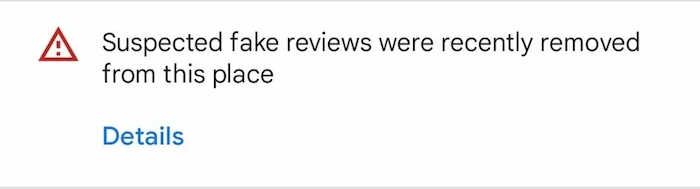
Google will delete your history, lock you from getting new reviews, and slap a visible “Fake Reviews Removed” badge on your map listing.
Yelp
90-day public consumer alerts.
🛑 HIGH
A massive pop-up banner is placed over your profile explicitly warning customers that you’ve been caught buying reviews.
State Attorneys General
State court lawsuits & forced audits.
🛑 HIGH
Local authorities can freeze business assets and place you under mandatory, multi-year state compliance monitoring.
CRM Software (Jobber, ServiceTitan, etc.)
Permanent API & account disconnection.
⚠️ MODERATE
If your review software uses illegal filters (review gating), tech platforms will cut off your scheduling and dispatch database entirely.
Google’s fake review removal banner.
Why Is Review Manipulation Suddenly an Issue?
As we wrote back in June 2024, online reviews have always been important – and will likely only become more important. And with the acceleration of AI integration into search, that prediction looks to be spot-on. If you started investing in online review gathering two years ago, your digital marketing is probably in a strong position right now.
Review manipulation has always been against the rules, but it’s in the spotlight now because how people search for local businesses is changing. With the rise of AI-driven search—like Google’s AI Overviews—search engines don’t just show a list of websites anymore. They read your reviews to decide if they should recommend you.
Because of this, online reviews have become the primary “social proof” that tells a search engine your business is trustworthy.
Here is why platforms are suddenly policing this so aggressively:
AI Reads Your Reviews: Google’s AI actively scans the text of your reviews to summarize your business for users (e.g., “Customers frequently praise their quick response times but note higher weekend rates”).
Search Engines Need Accurate Data: If Google’s AI recommends a plumber based on fake, forced, or coached reviews, and that plumber does a terrible job, the user loses trust in Google.
Patterns Stand Out: Algorithms are incredibly good at spotting unnatural patterns. When a business suddenly gets dozens of reviews all using the exact same keywords or naming the same employee, it flags the system that something dishonest is happening.
Fake Signals vs. Real Signals
To protect the integrity of their search results, platforms use AI to separate natural feedback from manipulated text:
Manipulated Review Signals (High Risk)
Authentic Review Signals (Safe)
❌ Repetitive employee name-drops from forced staff quotas.
A mix of reviews where names are only mentioned naturally and occasionally.
❌ Coached keywords and specific city names stuffed into sentences.
Natural, conversational language describing the actual service experience.
❌ Reviews left on-site from a company-owned iPad or phone.
Reviews left by customers on their own personal devices and home Wi-Fi networks.
❌ A “perfect” 5-star profile where negative feedback is hidden or blocked.
A realistic profile with a mix of high ratings and handled negative feedback.
Questions About Building Your Online Reputation? Give Us a Call
Does it seem like online reviews have been around forever? Compared to the short history of the internet, they have. Yelp was founded all the way back in 2004. TripAdvisor is even older – it launched in 1996! And Google Reviews showed up in 2008.
So, there’s nothing new about online reviews, but they’ve never been more important than they are now. If you care about making sure that AI models find your business and recommend it to potential customers (and you should!), this is your last call to get onboard. The train is about to leave the station.

 (360) 433-9870