(360) 433-9870
Article Highlights aka: The TL;DR
- The Hidden Waste: Your sales team is labeling $150 leads as “dead,” when timing hesitation means they’re actually just paused—and quietly buying from your competitors.
- Zero-Ad-Spend Solution: An automated 7-day SMS workflow re-engages unclosed prospects right when their hesitation cools, without adding a single dollar to your acquisition budget.
- Proven Field Results: The initial test recovered 217 written-off sales, generating $174,769 in immediate first-year billing for a pest control client.
- The Compounding Payoff: Full automation turned 4 months of unclosed leads into $447,000 in lifetime contract value, compounding toward $2.3M over four years.
- The Takeaway: Stop throwing money at expensive new ad campaigns until you squeeze the high-margin revenue sitting untouched in your existing CRM.
You Paid For Them, But Some Of Your Leads Are Quietly Buying From Your Competitor.
Here’s an uncomfortable reality that most pest control owners don’t know: your sales team is unknowingly throwing away money you already spent on your advertising.
Not on purpose. Nobody walks into your office and purposely decides they are throwing leads away. It happens quietly, one “not interested” at a time. A prospect calls, your CSR or sales rep works them, the prospect hesitates, or ghosts, and the lead gets marked dead. Your team moves on to the next one. That lead, the one you paid your agency to generate, the one that cost you real money in ad spend quietly goes cold and silently buys from your competitor.
Multiply this by a year and you’re looking at a pile of revenue you already bought and never collected on.
We here at City Ranked decided to go get that revenue back. What follows is exactly how we did it, what it produced for one of our pest control clients, and why the real story isn’t the workflow we created, it’s the system it came from.
The “Dead Lead” is a decision, not a concrete fact
I’ll start with the decision that should bother you the most as a business owner: at this client, a qualified lead costs about $150 to generate. That’s real money out the door before anyone picks up the phone.
Now let’s think about what a “dead lead” actually means. It doesn’t mean the prospect no longer has pests. It doesn’t mean they solved the problem. In most cases it means they didn’t buy on that call, on that day, at that moment. Timing. Price hesitation. They wanted to talk to their spouse. Life happened, they got distracted, and never called back.
Your sales rep marks the lead as “not sold” and it quietly disappears. But the pest problem didn’t disappear. The prospect didn’t disappear. Your team just stopped talking to someone that you already paid $150 to reach.
That’s not a lost lead. That’s a paused opportunity. And a paused opportunity you paid for is the cheapest recoverable revenue in your entire business, if you have a system to go back and finish the conversation.
The workflow that solved the problem, in plain terms
When a prospect becomes a qualified lead, our Skout Marketing Automation system drops them into the client’s sales CRM, where their sales rep has five business days to close. Business as usual, the rep does their job.
The difference is what happens on day six. Instead of letting the unsold leads rot in the CRM, Skout pulls them back automatically and checks what service the prospect originally wanted.
On day seven, that prospect gets a limited time offer automatically delivered to them, framed as available for a short window. One question: are you still dealing with pests? If yes, the offer goes out by SMS, and at the same moment a supervisor on the client’s side gets pinged that a “dead” lead just raised their hand. The rep picks the conversation back up, schedules the service, and the sale closes like any other.
That’s it. No new leads. No new ad spend. Just a system that refuses to let a paid opportunity die on the vine.
What it did to the sales team’s head
Here’s the part that no spreadsheet will show you, and it might be the most important part.
Sales reps treat “no” and “ghosting” as final because they have to. They’ve got a full pipeline and limited hours; they can’t chase every maybe. So “not interested” quietly becomes a hard stop, and mentally, that lead is gone the second they mark it lost.
So “not interested” becomes the new hard stop, and your sales reps have been trained that the lead is gone, and to move on. This here is why only 37% of qualified leads on average make it into a PCO’s lead database.
This workflow quietly rewires that. Reps stop treating “no” as the end of the road, because they’ve watched leads they personally gave up on come back and close, without costing them a single minute of chasing. The system does the follow-up, engagement, qualification, and hand-off. The rep just answers the phone when a “dead” prospect meets the re-engagement thresholds.
That changes the emotional math of the whole sales floor. “No” stops meaning “lost” and starts meaning “not yet.” Reps get more at-bats without more effort, and morale climbs because the pipeline stops feeling like a leaky bucket. The system becomes gamified as sales reps start to compete on who will get these hot leads as they re-engage.
The real numbers on reactivated leads
We ran this workflow in two stages, and I’m going to show you both, because the two stages prove two different marketing exercises here at City Ranked.
- Stage one: We tested the workflow
We took the client’s not-sold leads and ran them through the limited time offer. To stay clean on SMS compliance, we only re-engaged recent leads, not ancient ones. That pilot recovered 217 sales the client’s reps had already written off, $174,769 in first-year billing and $90,593 in recurring annual value. These were dead leads, written off as unsellable. Now they’re customers.
- Stage two: we automated the re-engagement
Once we knew it worked, we turned it into a workflow that runs on its own, with no human intervention needed. No one sources a list. No one hits send. In its first four months of running automatically, it produced 104 more recovered sales, $82,340 in first-year billing and $44,228 in recurring annual value with effectively zero effort from the sales team, except to finalize the sale and schedule the service.
Now do the compounding math, because this is where pest control owners should pay attention. This client keeps a customer an average of four years. A recovered customer isn’t a one-time sale, it’s a multi-year revenue generator. Run the automated workflow forward: $82,340 in year one, plus $44,228 renewing for three more years, and that four-month batch of “dead” leads is worth roughly $215,000 in lifetime contract value. The automated workflow, on the same math, is worth roughly $447,000.
All of it from leads that cost about $150 each and were already sitting in the “not sold” pile.
Now watch the revenue compound
Here’s what makes this different from a one-time win, and it’s the part worth reading twice to understand what AI and marketing automation can do for your business.
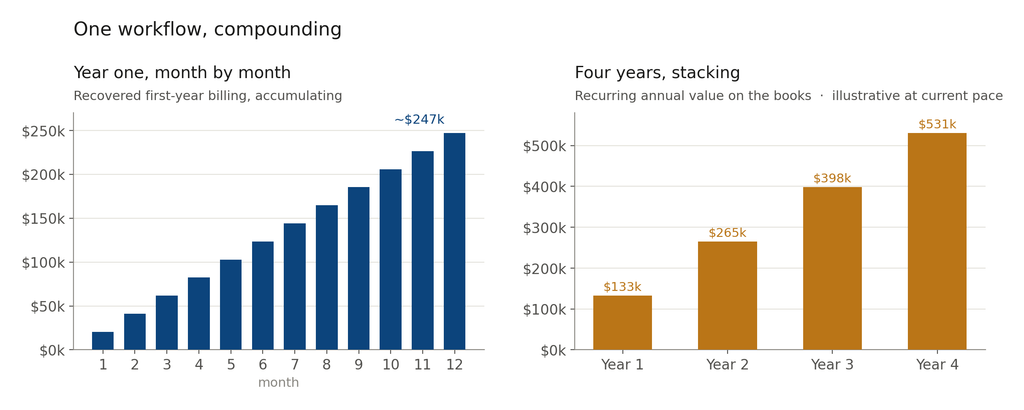
That automated engine settled into a steady pace: roughly $20,600 in new first-year billing and $11,100 in new recurring annual value every single month, all from leads that were already marked dead and unsellable.
So let that run for twelve months, at the same pace, and it stacks up. By the end of year one, this single workflow will have added about $247,000 in first-year billing, and, more importantly, built roughly $133,000 in recurring annual value that renews every year after. That recurring number is the one to watch, because it doesn’t reset. It’s a new revenue floor the next year builds on top of.
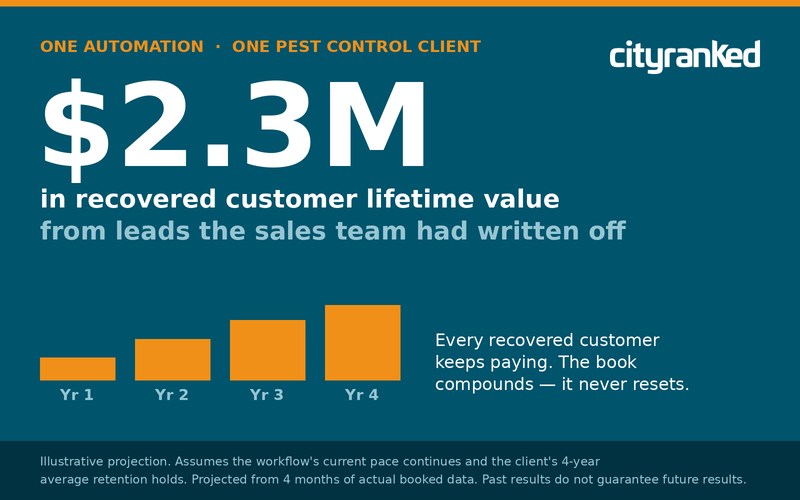
Now factor in that this client keeps a pest control customer an average of four years. Year two keeps year one’s recurring base and adds a fresh one. Year three stacks a third. If this one workflow simply holds its current pace, the recovered book compounds toward roughly $2.3 million in cumulative revenue over four years, not because it recovers more leads each month, but because nothing it recovers ever stops paying while new recoveries pile on top.
That’s the mechanic most operators never see. A workflow like this isn’t a campaign that spikes and fades. It’s an asset that accrues. And it’s one lever out of ten that City Ranked manages for each of our clients on our Digital Ramp marketing agreement.
Why your cost per sale just collapsed
Think about what that does to your acquisition math.
You already paid the $150 to generate each of those leads. That money was spent whether the lead closed or not. When the workflow recovers a sale from that pile, the marginal cost of that new customer is close to nothing, a text message and an AI automation connected to your CRM.
So every recovered sale drives your blended cost per acquisition down, not up. Your return on ad spend climbs, because you’re squeezing more customers out of the exact same ad budget you already committed. You didn’t spend more to grow. You just stopped leaving paid-for revenue on the floor.
That’s the opposite of how most agencies grow your numbers, they ask for more budget. This asks for more yield from the budget you’ve already got, all while training Google and Meta’s systems using our Skout IVR.
The real story isn’t the workflow. It’s the system that produced it.
The whole point of this article isn’t to promote this new workflow, but more that adoption of new technologies and systems should be something that PCO’s should be seriously considering, right now, today. The old way of thinking when it comes to marketing and advertising is dead.
The workflow above offer is not the offer. It’s just one example of how we operate as an extension of your team, to grown your business using out of the box thinking.
At City Ranked, ideas like this are created as Agile experiments, small, fast tests to see if something actually generates revenue. When an experiment proves itself, we don’t leave it as a clever one-off that depends on someone remembering to run it. We systemize the process. It graduates into a Waterfall workflow, part of the permanent marketing foundation that runs continuously, whether anyone’s watching or not.
That’s the whole point of our 10-Levers system. Most agencies run your growth on one or two channels and a monthly report that tells you what already happened. We run two marketing engines at once: one that brings in new qualified leads, and one that quietly goes back and works the customers and prospects you already earned: reactivations, upsells, second-chance offers, and many more, all run automatically in the background. All of them compounding lead production and revenue generation running silently in the background and managed by our team.
The 2nd Chance offer lives in that second engine. It started as an experiment. It proved out. Now it runs on its own, compounding every month it’s live.
And that’s the part most operators miss. A workflow like this doesn’t wear out, it gets stronger the longer it runs, exactly the way we just watched the numbers stack. Month twelve doesn’t look like month one. It looks like a moat your competitors can’t cross by outspending you, because it isn’t about spend, it’s about system built to generate real business growth.
Systemize your marketing processes to create recurring revenue engines
If you’re running a pest control company and you’re trying to fast-track growth, here’s the question worth sitting with: how many leads did your team mark “not sold” in the last twelve months, and what were they worth?
You already paid for them. Most operators have no system to go back and finish those conversations, so that revenue just evaporates, quietly, month after month.
We built a proven system that doesn’t let that happen. And this is just one marketing lever out of ten that our agency operates for our clients.
If you want to see the size of what you’re leaving on the table, we’ll show you. Our Revenue Recovery Audit looks at where your leads come from today, how exposed you are to a single channel, and how much recoverable revenue is sitting in your “not sold” pile right now. 15-minutes. No pitch deck. No commitment.
The leads you already paid for are worth more than the ones you’re chasing. Let’s go get them back.

Growing your business is a journey that begins with a single step. That step? Reach out to us and say hi.