
 (360) 433-9870
Google Just Retired the Blue Links. We’ve Been Building for This Since 2022.
On May 19th, at its annual I/O conference, Google did something it has been inching toward for years and finally committed to, in writing: it’s retiring the ten blue links interface we’ve all been accustomed to as the default search experience.
Not pushed them down the page, it’s planning to eliminate them.
What replaces them is what Google is now calling the Agentic Web, a search box that no longer hands you a list of websites to go visit, but instead understands your situation, synthesizes the options, builds a custom answer in real-time, and in a growing number of cases, takes the next action for you. It can compare providers, it can check availability, and it can place the call to a local business on the searcher’s behalf to book the job; all without the person ever landing on a website.
If you run a service area business like plumbing, HVAC, pest control, or something similar, read that last sentence again.
It can compare providers, it can check availability, and it can place the call to a local business on the searcher’s behalf to book the job; all without the person ever landing on a website.
The customer who used to find your listing online, click your website, then dial your number may never do any of these three things again. An AI Agent will complete these tasks, without the consumer talking to you, visiting your website, or even knowing your business.
For most service area businesses, this is the kind of announcement that sounds like yet another crazy Google change, and one more seismic shift on a platform they were already too dependent on, and all this arriving faster than they can plan for.
If that’s your feeling right now, I want to say something up front, because it’s the whole reason for this post:
This is not an emergency for you. We saw this coming, and have been building for this exact scenario since 2022.
We named this before Google confirmed it
I’ve been advertising home service businesses since 2004. In that time I’ve watched this industry move from the Yellow Pages to early internet search, from organic SEO, to pay-per-click, from local listings, to Local Services Ads. I have a long track record of identifying which shifts were noise, and which ones were ground moving. This one is earth shaking.
But it is not a surprise. Before Google made any of this official, we published our position. In our piece The Traditional Digital Agency Model Is Dead… Now What?, written and posted before Google’s I/O, we wrote:
“For most pest control companies, the majority of new customer leads flow through a single source: Google… That dependency is a risky structural vulnerability that most owners have never had to confront directly, because Google has been reliable enough, for long enough, that the risk felt theoretical.”
And then, in the same piece:
“Meanwhile, the noise is getting louder. GEO. AEO. AI Overviews. Machine learning optimization. Every week brings a new term, a new acronym, a new claim about what will determine who wins in search tomorrow.”
We didn’t write that to look clever. We wrote it because the signals were already there for anyone in this industry willing to read deeper into them. The turning point for us came in 2022, at a conference in San Diego, when it became clear that the technologies once locked away inside enterprise budgets; machine learning, AI-driven qualification, agentic automation, had quietly become price accessible. The barrier was no longer cost. It was knowing how to build them for this industry, service area businesses specifically.
So we started building back in 2022. Google’s announcement on May 19th did not change our plan. It validated it.
What actually changed — and what already answers it
Google unveiled four shifts at the 2026 I/O Conference: Google can now compare providers, can check scheduling availability, and can place the call to a local business on the searcher’s behalf to book the job; all without the person ever landing on a website. Each one of these new features corresponds to a piece of City Ranked’s Ascent Toolkit that has been battle proven, already runs in client accounts, and was built for this exact moment.
The customer stopped typing keywords and started describing situations
When it comes to AI search, searches like “Pest Control Las Vegas” rarely happen, instead most users will enter a prompt like: “I’ve got wasps in the soffit by my front door, I have kids so I need someone who can come today and takes Visa.” Google reads that scenario and looks for the business whose data actually answers it; service area, timeline, services, trust. In these searches landing pages optimized for broad keywords are invisible. This is precisely what GPS-SEO, Geo-Block, and CR Suite Schema were built to feed: hyper-granular signals that tell Google what you do, exactly where you do it, and why you’re the best business. All in the structured format the AI extracts from. Back in 2012, we deployed structured schema on some of the very first 1,500 websites in the country. The format Google now depends on to build its answers is one we’ve been fluent in for over a decade.
City Ranked was one of the first agencies nationwide to deploy schema markup on websites back in 2012. Back then, less than 1,500 websites had the code deployed on their websites, our clients were among the first.
Search became zero-click
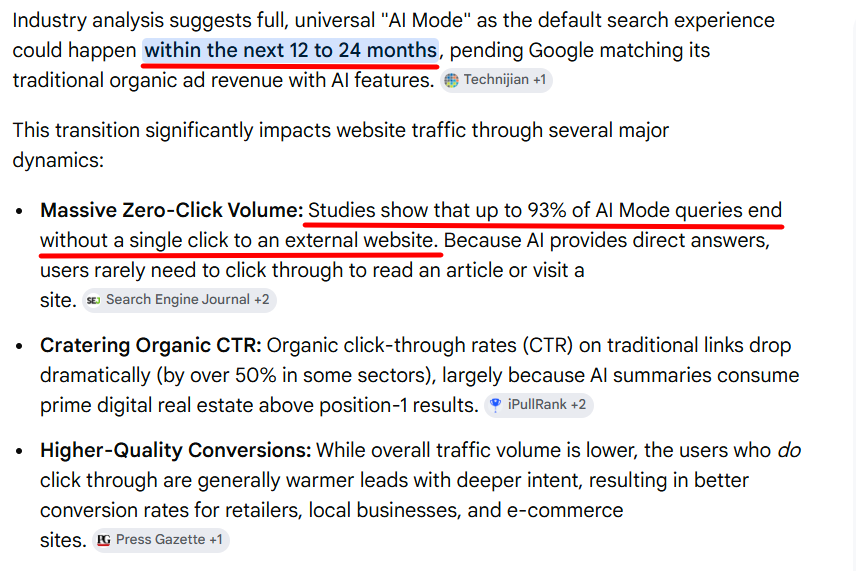
Google reported AI Mode has already crossed a billion monthly users, and organic click-through drops sharply the moment an AI summary appears, with these summaries resulting in 65% or more in zero-click searches. The lead that used to arrive as a website visit, now arrives as a direct action: a call, a booking, or it doesn’t arrive at all. That’s a problem only if your conversion happens on your website. Ours doesn’t. Skout engages every contact, caller, web visitor, DM, SMS, social message, and qualifies it before a human picks up, which means we were never depending on the click in the first place.
Google’s AI will now call local businesses and book jobs autonomously
This is the one that should keep your competitors up at night. When Google’s agent calls to confirm availability and to book a service, your front desk becomes the conversion funnel. If a business runs an outdated answering service that can’t confirm real-time availability, doesn’t answer the call, or worse, screens out an unrecognized AI Agent, it loses that job instantly. The AI Agent simply dials the next provider.
The Skout IVR was built to win this exact type of interaction: it engages the caller, classifies the intent of every inbound call the moment it arrives and fires the correct conversion signal back to Google, training the algorithm on what a genuine new-customer contact looks like. After implementing the IVR alone, our tracked CRM capture rates jumped from 37% to over 60%, with 80%+ projected once our call-intelligence layer launches later this year. The agentic call isn’t a threat to that system. It’s another contact it’s already designed to catch.
Local trust became the deciding currency
When the AI is synthesizing a recommendation rather than listing options, it leans on trust signals. A clean and well built Google Business Profile, high-velocity recent reviews, and hyper-local structured data. Summit Reviews has been building exactly that review velocity for our clients all along, because in local search, review volume and recency have always been direct ranking factors. The AI didn’t invent the importance of trust. It just made it part of the whole game.
Conversion Intelligence MarTech
There’s a fifth shift Google framed as advice to agencies: audit your client’s conversion infrastructure before the best marketing in the world goes to waste. For us, that audit isn’t a new service we scrambled to invent after Google’s I/O Conference. It’s the first stage of how we onboard every client — Basecamp, the Revenue Recovery Audit — and it has been since long before Google put it in a keynote slide, and our Skout IVR directly addresses our client’s conversion infrastructure – this is exactly why we built this.
Why this is an opening, not a threat
The shift away from the blue links isn’t the death of search marketing. It’s the death of lazy search marketing: generic pages, broad keywords, and answering services that drop the AI’s call. Every operator running on that old stack is about to get quietly removed from the recommendation set, and most won’t understand why, because their rankings report will still look fine while their phone goes progressively silent.
That gap is the opportunity. When a market full of competitors start to lose visibility at the same time, the few businesses whose data is structured, whose reviews are current, and whose intake can catch an agentic call don’t just survive the transition, they absorb the market share the others are leaking. Early movers in a disruption like this don’t gain a few points. They redraw the map.
We here at City Ranked saw this exact scenario play out in the early days of review generation on publisher platforms like Google Business Profile. The companies that took review generation serious from the start, ruled local map pack rankings for years to come. Early adopters reaped the rewards.
If you’re already a City Ranked Skout client, you are on the right side of that line. The system catching your leads today is the same system built to catch the AI’s call tomorrow. Nothing about May 19th Google announcement should have you worried, we already have the systems built and ready for deployment.
I’ve watched this industry navigate every major shift in digital advertising for over twenty years. The ones who win this next platform shift won’t be the ones with the biggest budget. They’ll be the ones who were already built for it before it arrived.
We saw the ground moving in 2022. We’ve spent the following years since making sure that when it finally shifted, our clients wouldn’t feel it.