(360) 433-9870
Does GPS-SEO work to rank your service area business better in local search results?
Article Highlights aka: The TL;DR
- City Ranked’s GPS-SEO helps service area businesses rank in cities, towns, and neighborhoods they serve, without using fake or virtual office addresses that can get listings suspended.
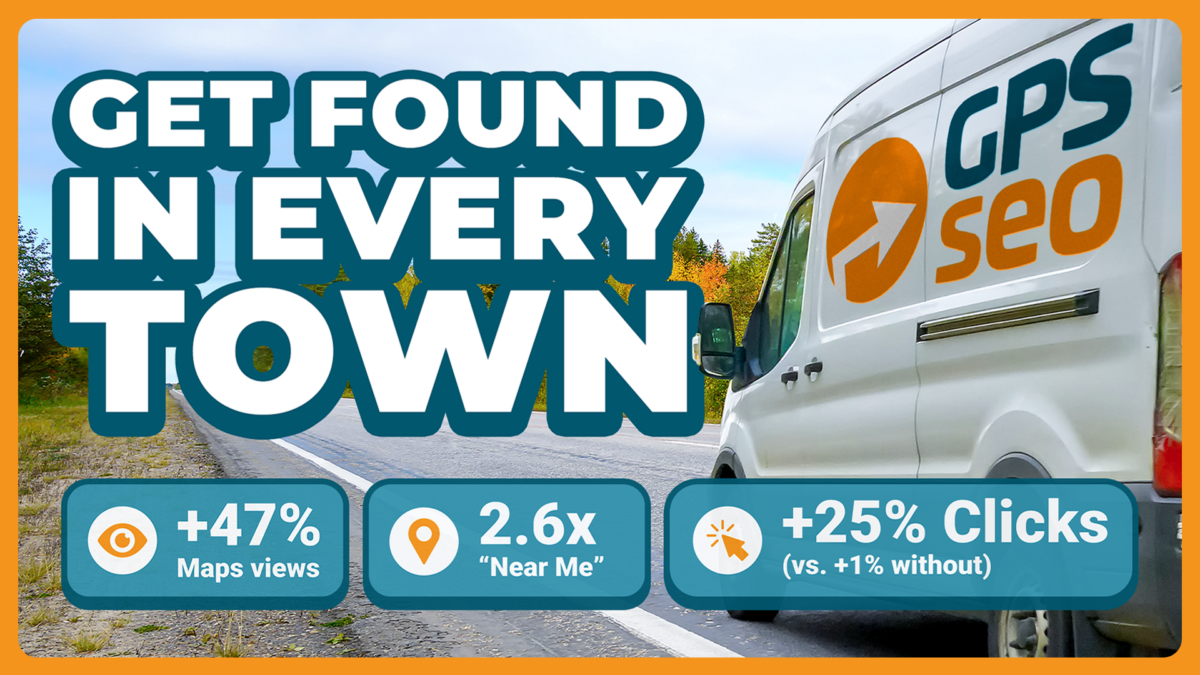
- Study 1: a multi-state home services provider, three years on GPS-SEO. After we rebuilt the program, Maps views at the same locations rose 47% in a year, and page-one rankings for “near me” searches went up 2.6x.
- Study 2: a national brand rolling GPS-SEO out market by market. Markets with it grew Google clicks about 25%. Markets without it grew about 1%.
- AI Overviews are taking clicks from how-to content, but local searches are still turning into booked jobs. That’s where our GPS-SEO works.
- It keeps working because we consistently keep it updated (since 2012). It’s not set-it-and-forget-it.
The fake office or virtual Google Business Profile address era
Back around 2012, a lot of SEO companies had the same advice for service area businesses that wanted to rank in more hyper-local searches: open another office. Not a real one. A mailbox, a virtual suite, a shared desk somewhere near the center of the city you wanted to show up in. Put that address on a Google listing, knowing it wasn’t true, and build your entire local SEO strategy around an untruth.
For a while, these tactics worked. Then Google caught on and started suspending those listings. The owners who paid for those addresses ended up with nothing to show for it. Lost reviews, lost rankings, and lost revenue was the result while these businesses were forced to scramble to replace what was lost.
We never sold that advice, in fact we’ve always advised against it. City Ranked doesn’t use tactics that break Google’s Business Profile policies and guidelines, period. But the problem those fake offices profiles were trying to solve was real, and our clients had the same issue. So instead of renting mailboxes or using virtual offices, we started building and testing a better way to communicate to Google where a business actually works. This became our GPS-SEO product, something we’ve been actively developing and using on client websites since 2012.
I still get asked the same question I got back then: does GPS-SEO actually work? And now, almost 15 years later: does it still work now that AI has taken over search?
This post is my answer to these questions, with the hard numbers from two of our clients behind it, and over 100 Google Business Profiles across the United States studied.
The hyper-local SEO need hasn’t changed
If you run a service area business, you already know this one. You might cover 30 or 40 cities, towns, neighborhoods, or areas. Your trucks service and are regularly in every one of these areas. But Google ranks your Business Profile mostly by how close the person searching is to your address.
So you show up great in the town where your office sits. Two towns over, where you have just as many customers, you’re on page three of the map. Or not there at all, and this is a problem every home services and service area business faces, especially when looking to expand operations.
That’s the gap the fake and virtual offices were trying to close. It’s also the gap most home services companies still live with today. Plumbers, HVAC, pest control, roofers, landscapers. Same story, same core issue, just different businesses.
Your customers don’t search for your address. They search for help where they live. Our GPS-SEO website software helps search engines understand exactly what you do, and where you do it, and we’ve continually proven this since 2012.
And more of them search without typing a town at all. They type “near me,” or even no city or town at all, and Google decides who’s near.
What our GPS-SEO does
GPS-SEO is our most popular website SEO software product. In simple terms, it tells Google exactly where you work, down to the neighborhood, and connects the pages for those areas to the right Business Profile. No fake addresses. No rented suites. No virtual offices. Just a clear, accurate picture of your real service area that search engines like Google, Gemini, ChatGPT and others read and understand.
I’m not going to walk through how we build our GPS-SEO as I’ve written about it several times, but will take an excerpt from a previous blog post: ‘Through hyper-granular local signal injection, GPS-SEO anchors your business to specific neighborhoods, suburbs, and zip codes, helping to attain search rankings including Google’s Map pack. When a homeowner three towns over searches “termite inspection near me,” your chances for appearance are much greater. Tested and proven in some of the most competitive markets in the country.’
- Get your Business Profiles found in the map results across the towns you serve, not just the one you’re in.
- Send local searchers to a page about their area, so the click lands somewhere that makes sense to them.
- Lift your main service pages over time, because Google understands where you do that work.
The first goal is the big one. For a service area business, the map is where buying decisions are made and the prospect picks who to call.
One more thing, and it matters for everything below: GPS-SEO isn’t a set-it-and-forget-it product. Google changes. Your service area changes. New code is introduced. We maintain and update the program the whole time it runs. You’ll see why that matters in the first study.
Study 1: a multi-state home services provider, three years in business
This client is a home services provider with locations across several states. GPS-SEO has been running on their website since 2023. That’s long enough to answer the question I care about most: does it keep working after the first big SEO jump, or does it fade over time?
Here’s the honest version. It didn’t climb in a straight line.
In the first year we measured, the program held its ground, growing modestly. The client was new, the brand was new, and it entered one of the most competitive home services verticals there is.
Then, in late 2025 and early 2026, we rebuilt the program around the growth the client had seen. We moved it from a broad, state-level setup to a much tighter metro and city-level one, so every town got its own clear signal. Over the next year, Google Maps views at those same locations jumped about 47%.
That’s what I mean by maintained. The software didn’t get lucky. We continued to updated it, and the results continue to grow.
| What we measured | Change |
|---|---|
| Maps views, same locations, year 2 (after the rebuild) | +47% |
| Direction requests, same locations, over two years | +38% |
| Times the Business Profiles showed up on service searches | about 3x more |
| Top-3 spots in the map results, searches that name a town | +16% |
| Page-one rankings, searches that name a town or say “near me” | +35% |
| Page-one rankings, “near me” searches only | 2.6x |
| Website form leads, this year | +9% YoY growth |
The local pages did their job too. About two-thirds of everyone who came to the site from Google landed on our hyper-local SEO program, most of them by clicking local results, interacting with the clients Google Business profile.
The part most agencies would leave out
This client’s total Google traffic went down this year, by about a quarter.
I could hide that, but we as an agency knew this due to changing search results based on AI overviews. Half of the loss came from a handful of popular how-to articles. One of them ranked near the very top of Google this summer. But the share of people who click it fell from about 1 in 80 to about 1 in 1,100. Google now answers that question right on the results page with an AI Overview, and the searcher never needs to visit. Most of the remaining lost traffic was attributed to non-buying searches the client was showing up for, but now results were just being consumed directly from the search engine.
That’s happening to informational searches and content everywhere. What it didn’t touch was the hyper-local, high-intent side. While the how-to traffic dried up, this client’s map visibility, local rankings and form leads all kept growing.
AI can answer a how-to question. It can’t send a technician to your house. (yet) The searches that turn into booked jobs are local, and that’s exactly where GPS-SEO works.
Study 2: a national brand, market by market
The second client is a national brand where local owners serve families in their homes. Each owner covers their own territory, so it’s the same service area problem, just spread across over 100 markets.
This one gave us something close to a controlled test. Every market got the same newly redesigned and optimized website; at the same time. But GPS-SEO was rolled out in phases, a group of markets at a time. So for most of this year, some markets had it and some were still waiting. Same brand, same site, same season. The only real difference was the GPS-SEO, and the territory location.
Here’s what happened to Google clicks on each market’s local pages, comparing this summer to last summer:
| Markets | Change in Google clicks (typical market) |
|---|---|
| With GPS-SEO launched | +24% to +25% |
| Still waiting for GPS-SEO | +1% |
That’s about a 24-point gap from one hyper-local SEO change.
Some of the markets went with our advanced version, which builds out pages for more of the towns and neighborhoods they serve, with greater degrees of local optimization. Those markets showed the biggest jump in local rankings. In about five months, the number of local searches where they ranked on page one went up roughly 4.3x. These are searches that name a town or county, or say “near me.” Today, more than half of their page-one rankings are local searches, up from about a quarter.
Standard GPS-SEO vs. our Advanced GPS-SEO results
To be fair about it, page-one counts went up in every group as the new website was indexed. Territories that included our advanced level GPS-SEO rose about 2.2x. Markets on the standard GPS-SEO optimization rose about 1.7x on this measure, but they grew clicks just as fast as the advanced markets. The advanced markets simply pulled away on rankings, which is what you’d expect when you cover more towns.
These are early results. The advanced markets have about five months of data to compare year over year. I’ll update this post when they hit a full year.
Why our GPS-SEO keeps working
Two very different businesses. One has been on GPS-SEO for three years, the other for a few months. The pattern is the same in both: more visibility in the map, more page-one rankings in the towns they serve, and more of the right people landing on the right pages.
It keeps working for three reasons.
- It’s built the way Google wants. No fake addresses or virtual offices, nothing to get suspended. When Google cracks down on shortcuts, and it always does, there’s nothing here to lose, because it’s been delivered the way these search engines want to consume.
- It gets maintained. Google changes how it ranks local results. Your business opens new markets, closes others, moves offices. A program built in 2023 and never touched would slowly stop matching how your business actually works. The first study shows what happens when you keep it current: year one, a predicable increase, year two, a rebuild, then a 47% jump.
- It works where the money is. The searches AI is taking away are the questions. The searches still turning into booked jobs are local: a service, a town, right now. That’s the ground our hyper-local GPS-SEO was built to win.
I’ve been doing this for nearly 25 years. I’ve watched a lot of tactics work for a year and then disappear. This one is still growing more than a decade after we started building it, because we never stopped updating it.
Questions worth asking your agency
If you’re not sure where you stand, here are a few questions I’d ask whoever handles your local SEO today:
- Is any of my ranking built on an address where we don’t actually work? If the answer is yes, or you get a long pause, you have a risk sitting on your account right now.
- Do I show up in the map in the towns I serve, or just the one my office is in? Simple searches in Google Search Console and GBP Insights will answer this question.
- When was my local SEO last updated? If it was built once and left alone, it’s probably falling behind.
- Where do people land when they click my Business Profile? Your home page, or a page about their area?
- How much of my traffic loss is AI Overviews, and how much is local? Those are two very different problems with two very different fixes. Again this can be easily researched using search console and GBP Insights.
If the answers to questions make you uncomfortable, that tells you something could be off.
See what GPS-SEO would do in your markets
Every service area is different. Some of our clients cover a handful of towns, some cover several states. If you want to know where you’re winning, where you’re invisible, and what it would take to show up across your service area, let’s talk.
Book a 15 Minute Discovery Call Today

Growing your business is a journey that begins with a single step. That step? Reach out to us and say hi.
How we measured
Both studies compare the same months year over year, so seasonality doesn’t skew the results. Data comes from Google Search Console, Google Business Profile Performance and Google Analytics.
Study 1: Maps views and direction requests count only locations open in all three years (June to September, 2024 to 2026). Map and page-one figures compare late September and early October, 2025 to 2026. In mid-September 2025, Google changed how Search Console counts impressions and rankings for every website, so we only compare periods after that change. Visit and lead figures compare June to September 2025 and 2026.
Study 2: Click figures compare June to September 2025 and 2026, using the middle (median) market in each group. Page-one figures compare two equal windows in 2026: late April to early May, and mid to late September.
Results reflect GPS-SEO together with ongoing Business Profile management, which run as one program. Client names withheld.