
 (360) 433-9870
Your business has value, but if your digital content doesn’t connect with the right people at the right time, that value goes unnoticed. And with AI and zero-click optimization, your online presence is more important than ever.
So the key here is that your content has to be effective. An effective digital content strategy is about creating the right content that solves real problems for real people.
You can’t forget the benefits of good content, such as increased engagement, better visibility to your target audience, and more brand awareness.
What does ‘good’ content look like?
Good content feels like a conversation with a trusted expert, not a sales pitch. It answers questions before customers even ask them. When someone lands on your site feeling confused or frustrated about a specific pain point, good content makes them think, ‘finally, someone who gets it.’
Instead of talking about how great your services are, it shows how you solve specific problems. It builds trust by providing real value before asking for anything in return.
For example, if someone is experiencing a faucet leak in their kitchen, they’re likely going to search ‘how to fix a kitchen faucet leak.’ If your content is visible to them (or even better, a top result in search), you’ve got yourself a potential lead!
It’s all about strategy: knowing your audience, setting clear goals, choosing the right channels, creating with collaboration, measuring, and auditing. And a checklist will help you get on track.
Content Marketing Strategy Checklist
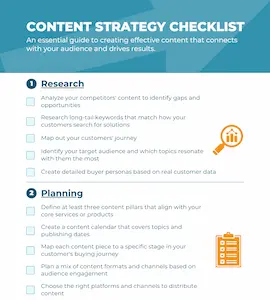
Standard PDF Checklist
This checklist breaks down the essential elements of a content strategy that actually delivers results.
Download our fillable checklist to track and complete each step of your content strategy, from research to measurement:
Research
Research uncovers your customers’ biggest challenges, frequently asked questions, and places they consume content.
- Analyze your competitors’ content to identify gaps and opportunities.
- Research long-tail keywords that match how your customers search for solutions.
- Map out your customers’ journey.
- Identify your target audience and which topics resonate with them the most.
- Create detailed buyer personas based on real customer data
Planning
A solid content plan smooths out your workflow and aligns the seasonality of your industry.
- Define at least three content pillars that align with your core services or products.
- Create a content calendar that covers topics and publishing dates.
- Map each content piece to a specific stage in your customer’s buying journey.
- Plan a mix of content formats and channels based on audience engagement.
- Choose the right platforms and channels to distribute content
- Establish a consistent brand voice guide.
Creation
Whether you’re using AI in your content creation or not, there are some elements to consider to avoid being blacklisted.
- Write compelling headlines that promise a clear benefit or solution.
- Include real-world examples and case studies that prove your points.
- Add relevant images, charts, or graphics.
SEO Optimization
Search engine optimization (SEO) remains a crucial part of content and brand visibility.
- Write SEO titles and meta descriptions that accurately summarize content and encourage clicks.
- Add internal links.
- Optimize images with descriptive alt text.
- Structure content with proper heading hierarchy (H1, H2, H3).
- Include schema markup to help search engines understand your content’s context.
- Optimize for search engines and social media
- Reduce page speed (under three seconds).
Publishing
You have to make sure your audience actually sees your content. So you have to consider where content lives and which channels to share it on.
- Reach out to industry partners or customers mentioned in your content.
- Update older content with fresh information and examples.
- Engage with early comments and questions to spark discussion.
- Use a content management system (CMS) to publish content.
Measurement
Consider what success means to you, starting with establishing metrics and KPIs.
- Set up Google Analytics goals to track meaningful actions (beyond visits).
- Monitor organic traffic growth for each piece.
- Measure conversion rates from content to leads or sales.
- Identify your top-performing content and analyze why it works.
- Review search console data to find new keyword opportunities.
- A/B test headlines and CTAs to improve performance.
How Brand and Content Marketing Work as One
Your brand is the feeling people get when they interact with your business. Content marketing brings that feeling to life through every article, guide, and resource you create.
Content is a continuous, ongoing process. When brand and content align, your expertise shines through and cuts through the noise. Customers start to recognize and trust you before they even need your services. This alignment creates a compound effect where each piece of content strengthens your overall brand presence.
Content marketing isn’t a big mystery, it’s still a powerful tool in capturing and converting leads.
Your Brand Marketing, But Better
You’ve got a lot on your plate. We have a team of experts ready to take on these challenges for you.
At City Ranked, we start by diving deep into your industry, understanding your customers’ pain points, and identifying SEO opportunities.
Our approach treats content like the strategic asset it is. We build durable strategies based on proven principles and current best practices.
The result? Content that establishes your authority, builds trust with your audience, and consistently drives qualified leads to your business. So reach out to our team today and we’ll begin the conversation of better conversion.